
Blog / Insights
InsightsThe Truth About Amended Return Processing Times
November 26, 2026 · 10 min read · By the SFG Capital team
IRS Processing Time for Amended Returns in 2026
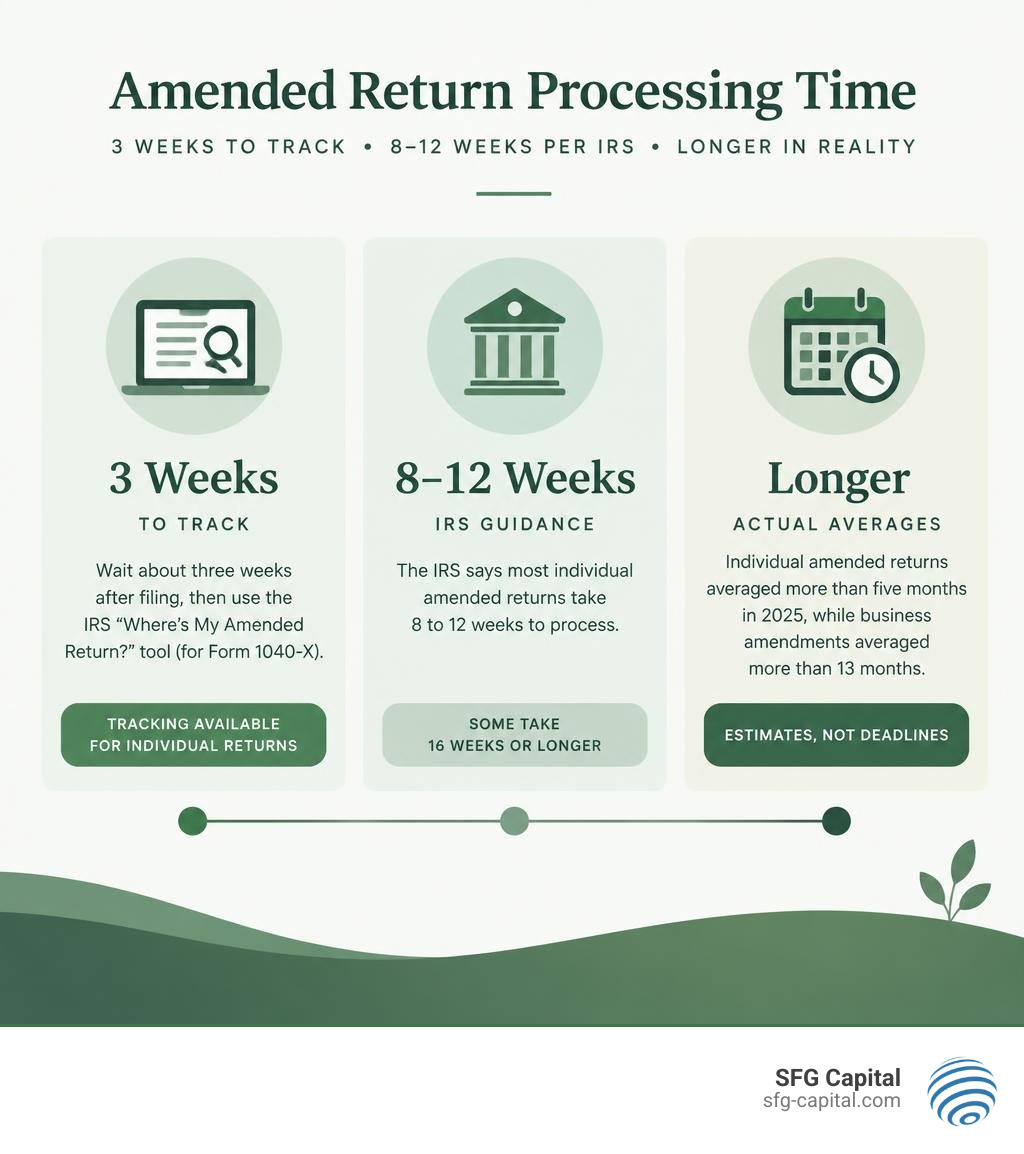
The IRS says most individual amended returns take 8 to 12 weeks to process, but some take 16 weeks or longer. In practice, the wait can be much longer: individual amended returns averaged more than five months in fiscal year 2025, while business amendments averaged more than 13 months. These are estimates, not deadlines. Your timing depends on the IRS workload and the review your claim needs.
To check a Form 1040-X, wait about three weeks after filing, then use the IRS Where’s My Amended Return? tool. It does not track business amendments such as Form 941-X, including Employee Retention Credit (ERC) claims.
I’m Santino Battaglieri, founder of SFG Capital. My nine-plus years in financial services and work funding ERC claims have shown me why the IRS processing time for amended returns matters to businesses waiting on a refund.
IRS processing time for amended returns vocab to learn:
- federal tax return process
- how long after filing taxes do you get your refund
- income tax refund process
What Is the Actual IRS Processing Time for Amended Returns?

Waiting on an amended tax return can feel like sending paperwork into a black hole. When you file an original tax return electronically, the processing cycle is often predictable. An amended return, however, follows an entirely different administrative track. Understanding realistic turnaround times prevents unnecessary panic and helps you plan your personal or business cash flow.
Official IRS Guidance vs. Actual IRS Processing Time for Amended Returns
The official stance from the agency states that taxpayers should allow 8 to 12 weeks for an amended return to be processed, with more complex submissions taking up to 16 weeks. Yet, looking at the published IRS processing status for tax forms, real-world operational speeds tell a different story.
During Fiscal Year 2025, the IRS processed approximately 3.7 million individual Form 1040-X submissions, with an empirical average turnaround time exceeding five months. As of November 2026, the paper processing inventory shows examiners only recently working through paper Form 1040 series amendments received in August 2026.
Several factors drive this gap between published estimates and reality:
- Staffing Constraints: The IRS workforce shrank roughly 27% in 2025, drastically reducing the number of human examiners available to review manual adjustment queues.
- Paper-Heavy Workflows: Even when Form 1040-X is submitted electronically, it frequently drops into manual handling queues if supporting schedules require cross-referencing.
- Inventory Backlogs: High seasonal volumes compound existing queues, meaning taxpayers must actively plan for navigating the 2026 IRS refund backlog.
If you are a business owner or individual facing extensive delays on substantial claims, See if you qualify for liquidity solutions with a short form, no documents to start, and no upfront cost.
Why Form 1040-X Takes Longer Than Original Tax Returns
Why does an amended return take months when an original e-filed return can be approved in 21 days? The answer lies in verification protocols.
Original e-filed returns move through automated algorithms. In contrast, amended returns must reconcile newly reported numbers against data already permanently recorded on the IRS Master File. While the IRS launched its 1040-X ‘Non-Complex’ Amended Returns Processing Automation on July 28, 2025, to accelerate straightforward adjustments for tax years 2023 and 2024, any filing with discrepancies still requires manual human intervention.
Internal rules outlined in 3.11.6 Data Processing (DP) Tax Adjustments dictate rigorous screening standards. Examiners must conduct:
- Schedule Verification: Cross-checking Schedule 1-A deductions, Clean Vehicle Credits (Form 8936), or Child Tax Credit recalculations against third-party reporting.
- Income Omission Checks: Flagging returns displaying a 25% or greater discrepancy in reported gross income.
- Fraud & Identity Filters: Screening via the Return Integrity and Verification Operation (RIVO) and Identity Theft Verification (IDTVA) units.
These mandatory checkpoints explain why your 2026 IRS refund might be taking extra time.
| Processing Stage | Original E-Filed Form 1040 | Amended Form 1040-X |
|---|---|---|
| Intake Mechanism | Automated direct database entry | Automated intake or paper mail sorting |
| Review Method | Algorithmic rules engine | Manual examiner review & data comparison |
| Verification Level | Basic identity & math check | Full Master File audit & schedule reconciliation |
| Typical Turnaround | Under 21 days | 8 to 16+ weeks (Averaged 5+ months in FY25) |
| Direct Deposit | Available on all standard returns | Available for e-filed 2021+ returns only |
How to Track Your Amended Return and Decipher IRS Transcripts

When monitoring your submission, standard tracking pages provide high-level updates, but tax transcripts offer the true operational picture.
Using Where’s My Amended Return and Understanding Status Codes
The primary tool for individuals is the Where’s My Amended Return? portal, also accessible via automated phone support at 866-464-2050.
You must wait roughly three weeks after filing before your details populate in the database. The system tracks the current tax year plus up to three prior tax years using your Social Security Number (or ITIN), date of birth, and ZIP code.
The system reports progress across three distinct milestones:
- Received: The IRS has received your Form 1040-X and entered it into the system. It is currently waiting in the processing queue.
- Adjusted: An examiner has reviewed your documentation and keyed in an adjustment to your tax account. This adjustment may result in a refund, an additional balance due, or a net-zero balance change.
- Completed: The processing cycle is finished. Any resulting notice or refund check has been mailed, or a direct deposit has been initiated.
Understanding these milestones helps clarify what taxes still being processed actually means for you during long silent periods.
Decoding Account Transcripts: Codes 971, 977, 290, 291, and 846
For a deeper look, request your IRS Account Transcript online. Transcripts record internal transaction codes weeks before the public tracking tool updates.
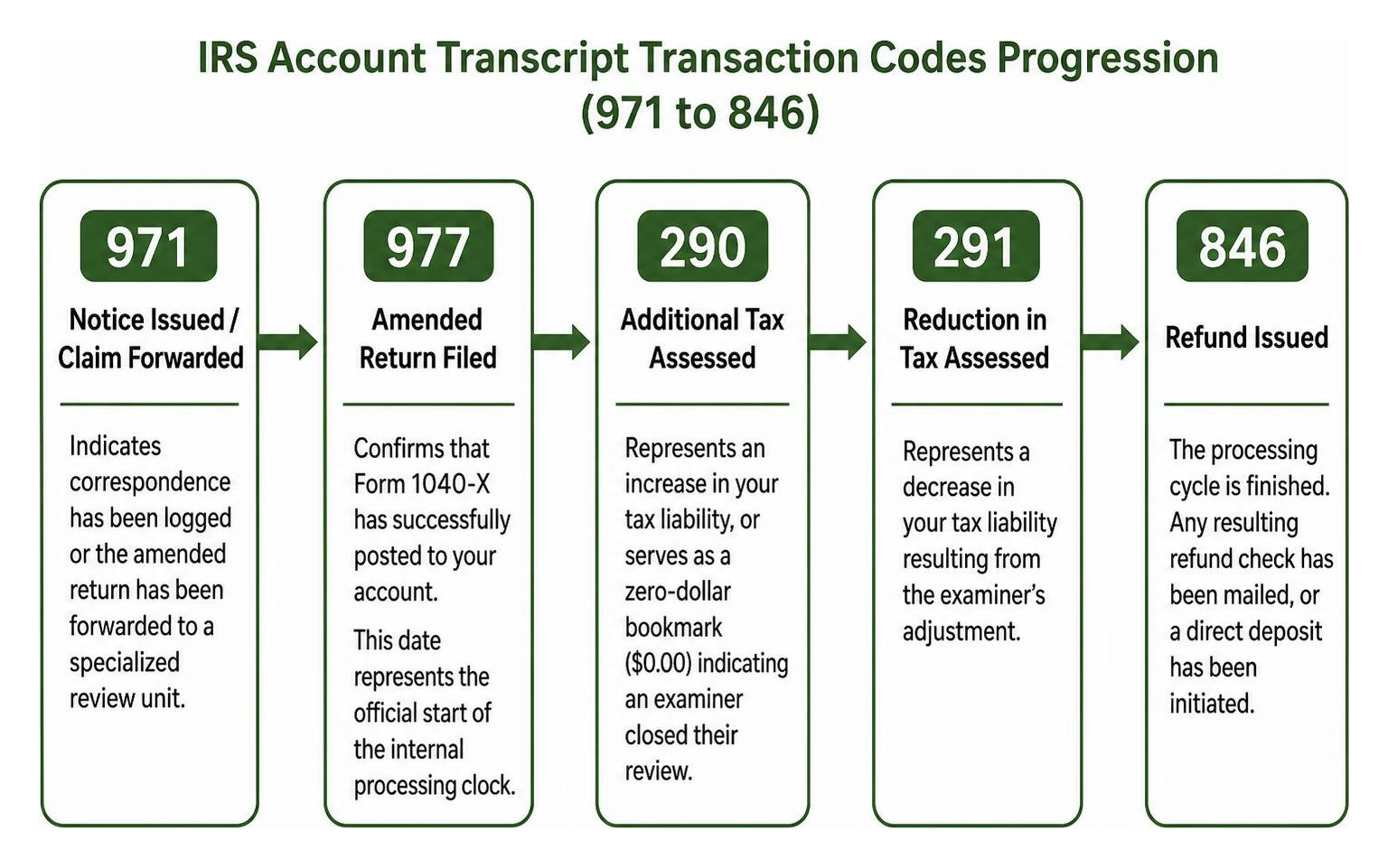
Look for these key transaction codes:
- Code 971 (Notice Issued / Claim Forwarded): Indicates correspondence has been logged or the amended return has been forwarded to a specialized review unit.
- Code 977 (Amended Return Filed): Confirms that Form 1040-X has successfully posted to your account. This date represents the official start of the internal processing clock.
- Code 290 (Additional Tax Assessed): Represents an increase in your tax liability, or serves as a zero-dollar bookmark ($0.00) indicating an examiner closed their review.
- Code 291 (Tax Abated / Reduced): Reflects a formal reduction in your assessed tax liability, which frequently creates an overpayment.
- Code 846 (Refund Approved / Issued): The final milestone confirming that your refund has been scheduled for direct deposit or paper check issuance.
If you notice a Code 971 without a corresponding adjustment code, it often indicates the IRS is holding my refund for review and I need answers.
Critical Filing Rules, Deadlines, and Financial Impacts While Waiting
Amending a return involves strict statutory boundaries and financial trade-offs that take effect the moment you submit your paperwork.
Statute of Limitations and Refund Claim Deadlines
Under federal law, you cannot claim a tax refund indefinitely. According to official rules on when and how to amend a tax return, you must file Form 1040-X within:
- Three years from the date you filed your original return (if filed before the April due date, the three-year clock starts on the April deadline); or
- Two years from the date you paid the tax, whichever is later.
Missing these windows permanently forfeits your right to claim an overpayment refund.
When you do file within the deadline, e-filed returns for tax years 2021 and later can receive refunds via direct deposit. However, paper-filed returns, older tax years, and submissions containing Form 8379 (Injured Spouse Allocation) will default to paper checks. Notably, adding Form 8379 pushes the estimated review timeframe up to 20 weeks. Understanding these variables clarifies how long after filing taxes do you get your refund.
Handling Balance Due, Penalties, and Collections During Processing Delays
If your amended return indicates that you owe additional tax, do not wait for the IRS to process Form 1040-X before sending payment.
Filing an amended return does not freeze interest or penalties. If you owe money, unpaid balances accrue a failure-to-pay penalty of 0.5% per month (up to 25%), alongside daily compounding interest. Submit your payment immediately alongside Form 1040-V (Payment Voucher) or via IRS Direct Pay to limit these charges.
Conversely, if the IRS delays issuing a refund past statutory deadlines, they generally pay you overpayment interest. That IRS interest is considered taxable income and will be reported on Form 1099-INT if it exceeds $10.
If you are currently waiting on substantial pending business credits and cannot afford to wait on IRS queues, See if you qualify for advance funding to access working capital quickly without upfront fees.
Escalation Procedures and Business Amended Returns (Form 941-X & Form 1120-X)
While individual filers face multi-month queues, business taxpayers encounter even more severe administrative hurdles.
Business Return Delays: Factors Impacting IRS Processing Time for Amended Returns
Amending business returns—such as Form 941-X for quarterly payroll taxes or Form 1120-X for corporate income taxes—involves an entirely separate workflow. In Fiscal Year 2025, the IRS processed roughly 1.6 million business amended returns, with turnaround times averaging over 13 months.
As outlined in the amended return frequently asked questions, business amended returns cannot be tracked using the standard Where’s My Amended Return web tool. Business filings must be handled manually by specialized examination units due to:
- Manual payroll tax and wage base recalculations.
- Mandatory cross-auditing against state unemployment records.
- In-depth compliance reviews surrounding complex incentive credits, particularly ERC claims.
Because business claims represent significant sums, waiting more than a year on manual IRS reviews can stifle commercial operations and payroll planning.
When and How to Escalate to the Taxpayer Advocate Service
If your individual Form 1040-X has exceeded the standard 16-week window with no status updates, or your business filing is stalled, you have several escalation options:
- Direct Phone Contact: Call the IRS individual support line (800-829-1040) or business line (800-829-4933) with your exact filing date and transcript in hand.
- Submit Form 911: Request intervention from the independent Taxpayer Advocate Service (TAS).
To qualify for TAS assistance, you must demonstrate significant economic hardship, such as an imminent risk of business closure, bankruptcy, eviction, or severe financial distress directly caused by processing delays. TAS can assign a dedicated case advocate to navigate internal examination holds.
If you need guidance on pending refund programs, you can also contact our team of specialists for information on non-bank claim advances.
Frequently Asked Questions About Amended Returns
Does filing Form 1040-X stop IRS collection actions or interest on an existing balance?
No. Filing an amended return does not pause active collections, bank levies, or penalty accruals on an existing tax assessment. The failure-to-pay penalty (0.5% per month) and statutory interest continue accruing daily until the underlying balance is paid or formally abated via Code 291. Taxpayers with balances due should pay estimated liabilities immediately upon filing.
Can I track business amendments like Form 941-X on Where’s My Amended Return?
No. The IRS Where’s My Amended Return online portal and automated telephone lookup tool track only Form 1040-X individual income tax returns. Business amendments (Form 941-X, Form 1120-X, Form 1041), injured spouse claims, and carryback applications (Forms 1045 and 1139) must be monitored via IRS Business Tax Accounts, tax transcripts, or direct phone inquiries with IRS business customer service.
What should I do if my amended return has been stuck on Received for over 16 weeks?
If your submission remains in ‘Received’ status beyond 16 weeks without moving to ‘Adjusted,’ pull your IRS account transcript to verify if Transaction Code 971 or 977 has posted. If no progress or correspondence is visible, call IRS customer service at 800-829-1040 to verify if your return was routed to a specialized review unit (such as RIVO or Error Resolution). If the delay causes severe financial hardship, file Form 911 for Taxpayer Advocate Service assistance.
Conclusion
Navigating the IRS amended return process requires patience and realistic expectations. While published agency guidelines suggest an 8 to 12-week turnaround, real-world processing backlogs mean individual returns often take five months, and complex business payroll adjustments can stretch past a year. Monitoring your account transcripts and keeping detailed records ensures you remain in control of your tax standing.
For businesses and individuals waiting on substantial government tax refunds, credits, or grants—such as the Employee Retention Credit (ERC), payroll tax credits, or tariff refunds—waiting indefinitely on government backlogs is not your only option. At SFG Capital, we help taxpayers across the United States access cash now from their pending government claims. All funding estimates and liquidity options depend on a complete file review, and we never charge upfront costs. See if you qualify today with our simple, short form to unlock your working capital.
See what your business may qualify for.
60 seconds. No documents. No upfront cost.
General information only, not legal or tax advice. Eligibility and estimates are fact-specific and subject to review.