
Blog / Insights
InsightsEverything You Need to Know About the Employee Retention Tax Credit
October 28, 2026 · 11 min read · By the SFG Capital team
What Is the IRS Employee Retention Credit?
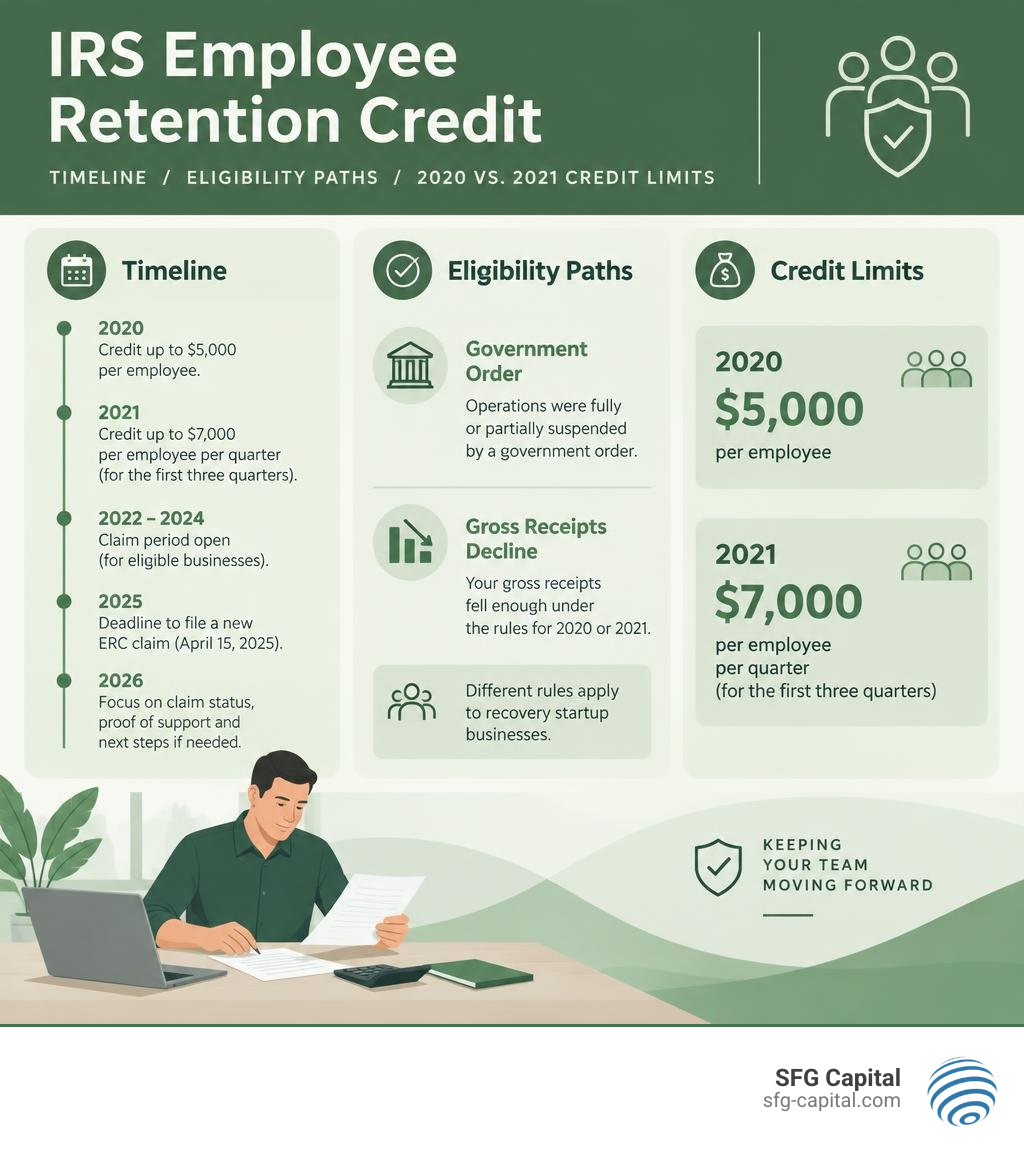
The Employee Retention Credit (ERC) is a refundable payroll tax credit for employers that kept workers on payroll during the COVID-19 pandemic. A business may have qualified if a government order suspended its operations or its gross receipts fell enough under the rules for 2020 or 2021. The credit can reach $5,000 per employee for 2020 and $7,000 per employee per quarter for the first three quarters of 2021. Different rules apply to recovery startup businesses.
The deadline to file a new ERC claim passed on April 15, 2025. If you already filed, the questions now are whether your claim is well supported, where it stands with the IRS, and what to do if you spot an error.
I’m Santino Battaglieri, founder of SFG Capital, with more than nine years of experience in financial services. SFG Capital has purchased and funded over $500 million in ERC claims, and my work focuses on careful reviews and funding options for businesses navigating the IRS Employee Retention Credit.
Irs employee retention credit terms made easy:
- amended 941 employee retention credit
- calculating employee retention credit
- irs form 941 employee retention credit
Understanding the IRS Employee Retention Credit and Core Eligibility Criteria
Congress introduced the credit under the Coronavirus Aid, Relief, and Economic Security (CARES) Act in March 2020. Lawmakers designed it to encourage employers to keep workers on payroll during emergency lockdowns. Subsequent legislation, including the American Rescue Plan Act (ARPA), expanded the credit amounts and extended eligibility windows into 2021. Reviewing Tax Relief for Businesses under the CARES Act highlights how the program grew from a modest relief measure into one of the largest corporate tax relief mechanisms in federal history.
Qualifying requires meeting specific statutory criteria. An eligible employer includes private-sector businesses and 501(c) tax-exempt organizations operating an active trade or business during calendar years 2020 or 2021. Household employers and government entities generally do not qualify, though tribal entities and public colleges or medical centers may meet exceptions. Eligible compensation includes both gross wages and allocable qualified health plan expenses paid to employees.
Evaluating qualification starts with understanding our essential guide to ERC eligibility requirements. Employers can also verify their historical qualification status using the official Employee Retention Credit Eligibility Checklist provided by the IRS.
Two Primary Qualification Pathways: Gross Receipts vs. Government Suspension
Employers qualify for the credit through one of two primary pathways:
- Full or Partial Suspension of Operations: A business experienced a mandatory disruption due to federal, state, or local government executive orders restricting commerce, travel, or group meetings due to COVID-19. General workplace advisories, OSHA bulletins, or voluntary safety adjustments do not qualify. The order must have exerted a direct, more than nominal effect on operations—generally defined as affecting at least 10% of total service capacity or operating hours. Guidance on qualifying during a partial shutdown explains how these disruptions applied to specific operating quarters. Supply chain disruptions only count if a direct government mandate shut down a primary supplier, preventing the business from sourcing essential inputs without alternative suppliers.
- Significant Decline in Gross Receipts: An employer experienced a verifiable drop in quarterly top-line revenue compared to the identical calendar quarter in 2019:
- For 2020: Gross receipts in a 2020 quarter dropped below 50% of receipts from the same quarter in 2019. Eligibility continues through the quarter in which receipts recover past 80% of the baseline quarter.
- For 2021: Gross receipts in a 2021 quarter dropped below 80% of receipts from the same quarter in 2019 (a 20% reduction). Employers could also use the alternative quarter election, using the immediately preceding quarter to establish eligibility.
Our revenue drop guide outlines these comparative quarter calculations. When performing these revenue checks, employers can rely on revenue procedures where the Safe Harbor Allows Exclusions From Gross Receipts for ERC Purposes, enabling businesses to exclude forgone Paycheck Protection Program (PPP) loan proceeds and venue grants from their gross receipt totals.
Employer Size Rules and Recovery Startup Businesses
Employee headcount rules dictate which wages qualify for the credit:
- 2020 Headcount Threshold: An employer with 100 or fewer average full-time employees in 2019 (working 30 or more hours weekly) can claim qualified wages paid to all employees during eligible periods. Employers averaging over 100 full-time employees can only claim wages paid to employees who were retained but not providing active services due to suspensions or revenue drops.
- 2021 Headcount Threshold: The threshold expanded to 500 average full-time employees in 2019. Employers with up to 500 workers can claim wages paid to all working and non-working employees during qualified quarters. Employers with more than 500 workers remain limited to non-working wages.
Our full-time employee guide explains the 2019 baseline hour calculations used for aggregation groups.
Congress also established Recovery Startup Businesses for the third and fourth quarters of 2021. A business qualifies as a recovery startup if it launched operations after February 15, 2020, and maintained average annual gross receipts of $1 million or less. Recovery startups did not need to demonstrate government shutdowns or gross receipt declines, though their credit is capped at $50,000 per quarter for Q3 and Q4 2021 under official Guidance on the Employee Retention Credit under Section 3134.
Calculating the Credit: 2020 Rules vs. 2021 Rules
Calculating the credit requires separating eligible payroll from other federal relief funding. Under CARES Act and ARPA guidelines, employers cannot use the same wages for both ERC and PPP loan forgiveness. Coordination rules prevent double-dipping while allowing businesses to optimize payroll allocations across both programs, as covered in our analysis of PPP and ERC coordination.

| Provision | 2020 Tax Year Rules | 2021 Tax Year Rules (Q1–Q3) | Recovery Startup (Q3 & Q4 2021) |
|---|---|---|---|
| Credit Percentage | 50% of qualified wages | 70% of qualified wages | 70% of qualified wages |
| Max Wage Cap | $10,000 per employee total for year | $10,000 per employee per quarter | $10,000 per employee per quarter |
| Maximum Credit | $5,000 per employee annually | $7,000 per employee per quarter ($21,000 max) | $50,000 maximum refund per quarter |
| Revenue Decline Rule | Greater than 50% drop vs. 2019 | Greater than 20% drop vs. 2019 | No revenue drop required |
| Small Employer Limit | 100 or fewer full-time employees | 500 or fewer full-time employees | Less than $1M annual gross receipts |
Calculating Your 2020 vs. 2021 IRS Employee Retention Credit Amounts
For 2020 claims, the credit equals 50% of up to $10,000 in qualified compensation per employee for the entire calendar year across eligible quarters. If an employee received $6,000 in qualified wages in Q2 and $6,000 in Q3, total eligible wages are capped at $10,000, yielding a maximum refund of $5,000.
For 2021 claims, the credit equals 70% of up to $10,000 in qualified wages per employee per quarter for Q1, Q2, and Q3. An employee receiving $10,000 in qualified wages each quarter produces a $7,000 credit per quarter, totaling up to $21,000 across the first nine months of 2021.
Employers claimed these refunds retroactively by amending your 941 for ERC filings, using Form 941-X to report wage totals and reconcile previously paid payroll taxes. Accurate reporting requires careful qualified wages calculation to remove wages paid to majority owners and related individuals.
Impact on Income Tax Returns and Wage Expense Deductions
Claiming the credit alters business income tax liabilities under Internal Revenue Code Section 280C. Under this rule, employers cannot claim a standard payroll tax credit and take a complete income tax deduction for the exact same payroll dollars.
When an employer claims the ERC, they must reduce their deductible wage expenses on their federal income tax return (Form 1120, Form 1120-S, or Form 1065) by the amount of the credit claimed for that tax year. If you claimed $100,000 in ERC for 2020 wages, your deductible wage expense for 2020 drops by $100,000, which increases taxable business income for that year.
This adjustment applies to the tax year in which the qualified wages were paid, rather than the year the refund check arrives. Official Notice 2021-20 guidance confirms that businesses must file amended federal income tax returns for 2020 or 2021 to adjust wage deductions and maintain compliance.
Claim Status, Processing Delays, and the Disallowance Wave in 2026
To combat aggressive marketing and invalid claims, the IRS instituted a moratorium on processing new ERC claims in September 2023. While the official deadline to file claims closed on April 15, 2025, the IRS continues working through a substantial inventory of pending submissions under strict review standards.
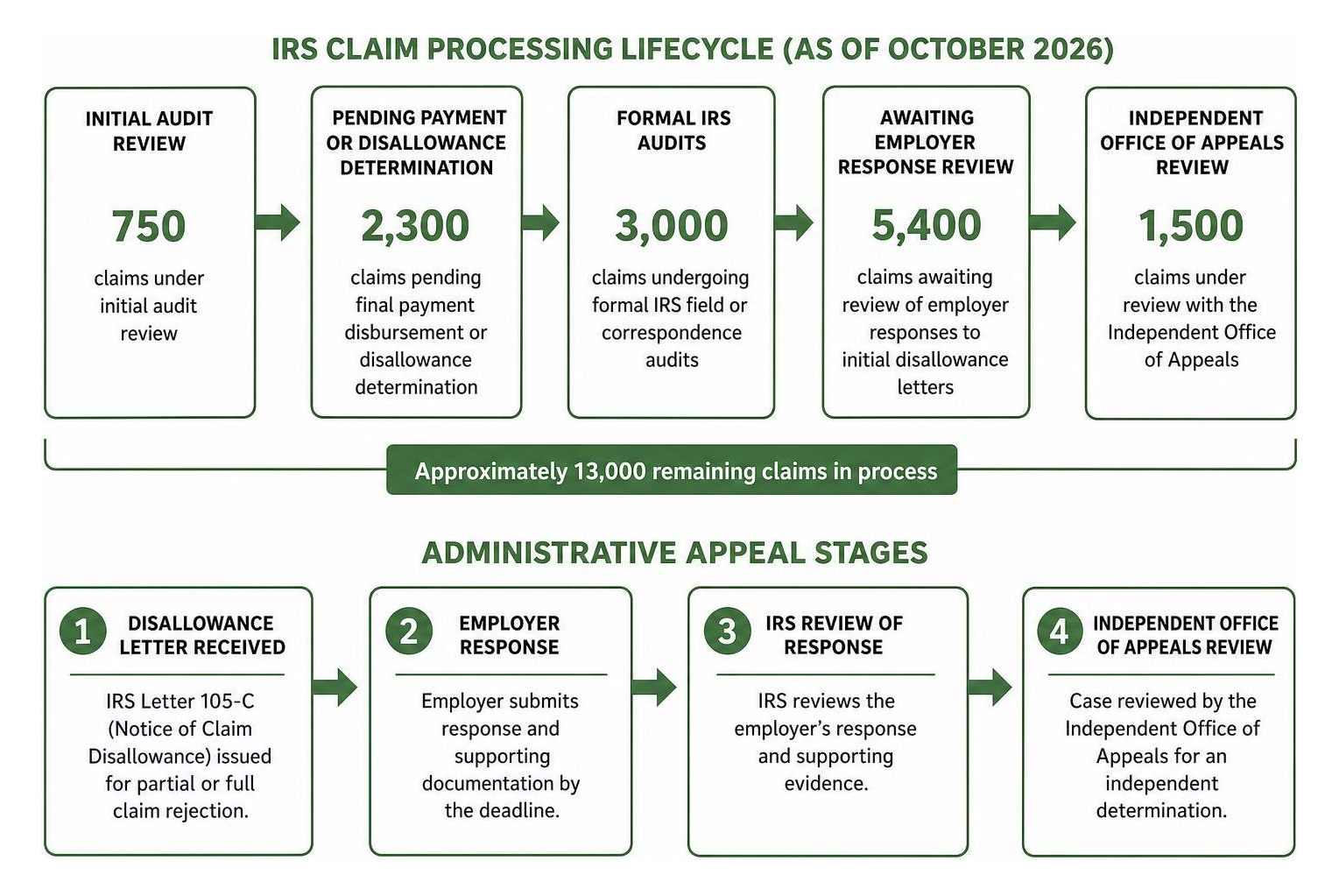
As of October 2026, the IRS has approximately 13,000 remaining claims moving through various stages:
- 750 claims remain under initial audit review
- 2,300 claims sit pending final payment disbursement or disallowance determination
- 3,000 claims undergo formal IRS field or correspondence audits
- 5,400 claims await review of employer responses to initial disallowance letters
- 1,500 claims are under review with the Independent Office of Appeals
Over recent years, the agency accelerated its enforcement efforts, issuing approximately 84,000 partial or full disallowance letters to businesses across the country. Navigating these notices requires understanding strategies for surviving the ERC disallowance wave, preparing for IRS notices and clawbacks, and evaluating options when handling ERC refund delays.
Responding to IRS Disallowance Letters and Administrative Appeals
A formal claim rejection arrives as IRS Letter 105-C (Notice of Claim Disallowance). This document details whether the IRS rejected your claim in part or full, often citing unsubstantiated supply chain claims or mismatched quarterly revenue data.
Recipients have specific options to defend valid claims:
- File a Formal Written Protest: You have 30 days from the letter date to request an administrative appeal with the IRS Independent Office of Appeals.
- Submit Substantiating Documentation: Provide direct copies of government executive orders, quarterly profit-and-loss statements, and payroll ledgers proving qualified wage allocations.
- Litigate in Federal District Court: If administrative appeals fail or the agency does not act, employers can file a refund suit in federal court within two years of the Letter 105-C mailing date.
For detailed procedural rules regarding administrative appeals and responses, consult the Frequently asked questions about the Employee Retention Credit published by the IRS.
Documentation and Recordkeeping Best Practices for IRS Audits
Because the statute of limitations for auditing 2021 Q3 and Q4 claims extends up to six years, maintaining thorough substantiation records is essential. Every business claiming the credit should store a defense file containing:
- Exact copies of municipal, county, or state executive shutdown orders citing mandatory operational limits
- Contemporaneous internal records showing the precise business functions suspended
- Quarterly profit-and-loss statements proving gross receipts calculations from 2019 through 2021
- Detailed payroll summaries, Form W-2 copies, and 941-X amended filings
- Worksheets showing non-duplication of PPP forgiveness wages and other pandemic tax credits
Organizing records using our structured refund checklist ensures your business can substantiate its qualification under IRS audit review.
Resolving Inaccurate Filings and Avoiding Promoter Scams
The rollout of the credit led to aggressive marketing from unregulated promoters and third-party fee mills. Many promoters mischaracterized basic supplier delays as qualifying government shutdowns, applied incorrect employee counts, or collected large contingency percentages on invalid claims. Federal enforcement intensified, and IRS Criminal Investigation launched 252 criminal inquiries into more than $2.8 billion of fraudulent ERC claims.
If you discover your business submitted an unsupported claim based on aggressive promoter advice, taking corrective action quickly helps avoid civil penalties and interest charges.
How to Withdraw or Correct an Ineligible IRS Employee Retention Credit Claim
The IRS provides mechanisms for employers to correct or withdraw improper claims before enforcement actions begin:
- Special Withdrawal Program: Employers whose claims have not been processed or paid—or those who received a refund check but have not yet cashed or deposited it—can request a formal claim withdrawal. The IRS treats withdrawn filings as if they were never submitted, removing related penalties and interest.
- Filing Corrected Form 941-X: If you received and deposited funds on an improper claim, you can file a new adjusted employment tax return to repay the credit balance and correct your payroll records.
Detailed instructions for claim withdrawal and error corrections are available on the Employee Retention Credit guidance resource page.
Bridge Funding and Claim Buyout Options for Pending Filings
Long processing backlogs and audits have left many businesses waiting months for valid refund checks. For companies in Austin and Travis County facing cash-flow constraints, waiting on IRS inventory reviews can disrupt hiring plans and capital expenditures.
At SFG Capital, we provide funding options to help businesses bridge this gap. Our services allow business owners to monetize pending claims without waiting for agency processing queues:
- ERC Advance Funding: Secure immediate liquidity backed by your documented, pending IRS refund, as explained in our ERC advance funding guide.
- ERC Claim Buyouts: Transfer your claim for an immediate cash payment, eliminating IRS collection risks and processing delays. Our breakdown of ERC buyout vs advance structures outlines the structural differences between these two options.
Every prospective filing undergoes thorough underwriting. Our team reviews payroll ledgers, shutdown documentation, and revenue tests to determine how ERC claims are valued, ensuring compliance before funds are distributed.
Frequently Asked Questions About the Employee Retention Credit
What was the final deadline to submit an Employee Retention Credit claim?
The final deadline to submit retroactive claims for all eligible quarters across 2020 and 2021 was April 15, 2025. The statutory assessment period has closed for new filings, meaning employers can no longer submit original or amended Form 941-X claims.
Can an employer claim the ERC if they also received PPP loan forgiveness?
Yes. Employers who received Paycheck Protection Program loans can claim the ERC. However, you cannot allocate the exact same payroll dollars to both programs. Payroll costs used to justify PPP loan forgiveness must be backed out before calculating qualified ERC wages.
What should a business do if its ERC refund has been pending for over a year?
If your claim has been pending with the IRS for over a year, verify that the agency has not sent an unreceived Letter 105-C or information request. You can check account status by ordering official account transcripts, working with a tax professional, or following our guide on checking ERC refund status. If your claim is verified and you need immediate working capital, bridge financing or claim buyout solutions provide direct access to liquidity.
Conclusion
The Employee Retention Credit provided crucial relief during economic lockdowns, but the program requires careful documentation and strict compliance. With new filing deadlines passed, business owners must focus on audit readiness, managing IRS review timelines, and responding promptly to administrative notices.
Whether you need to defend an existing claim under review, correct past filing errors, or bridge processing delays with advance funding, professional guidance protects your bottom line. SFG Capital helps businesses in Austin, Travis County, and across the United States evaluate pending claims, maintain regulatory compliance, and unlock needed working capital. Contact us today to access comprehensive business tax and refund solutions tailored to your operational needs.
See what your business may qualify for.
60 seconds. No documents. No upfront cost.
General information only, not legal or tax advice. Eligibility and estimates are fact-specific and subject to review.