
Blog / Insights
InsightsIRS Processing Status: Are They Behind on Your Refund Again?
November 18, 2026 · 8 min read · By the SFG Capital team
Is the IRS Processing Tax Returns in 2026?
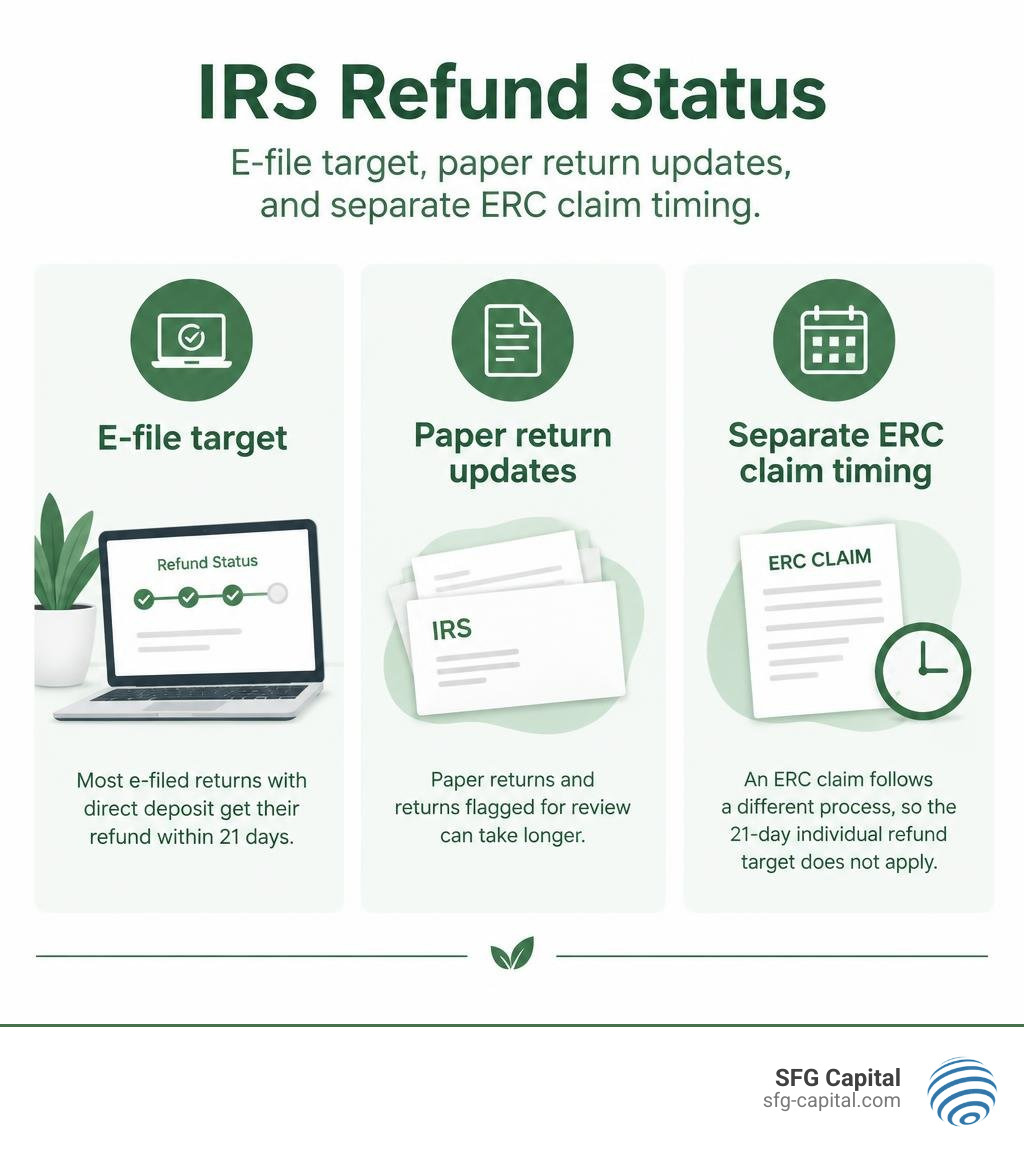
Yes. As of November 2026, the IRS is processing tax returns. Most people who file an accurate return electronically and choose direct deposit receive their refund within 21 days. Paper returns and returns flagged for review can take longer.
To check an individual refund, use the IRS Where’s My Refund? tool. For current paper-return processing windows, check the IRS tax form processing status page. An Employee Retention Credit (ERC) claim follows a different process, so the 21-day individual refund target does not apply to it.
I’m Santino Battaglieri, founder of SFG Capital, with over nine years in financial services and experience funding more than $500 million in ERC claims. When business owners ask whether the IRS is processing tax returns, I help them distinguish individual refund timelines from ERC claim delays and review their funding options.
Is the irs processing tax returns terms to know:
- average time for irs to approve refund
- how to check if my refund has been processed
- the irs is holding my refund for review
Is the IRS Processing Tax Returns on Schedule in 2026?

During the 2026 filing season, the agency processed nearly 139 million individual tax returns and issued more than 90 million refunds. Modernization efforts and automated ingestion pipelines have allowed the system to handle peak volumes of up to 1,200 submissions per second.
About 98% of individual returns were submitted electronically, and roughly 98% of all issued refunds were delivered directly via direct deposit. However, high overall volume does not mean every filer experienced a smooth turnaround. A budget reduction to $11.2 billion for FY 2026, alongside shifting workforce numbers, created bottlenecks for non-standard filings.
As detailed in the National Taxpayer Advocate delivers Fiscal Year 2027 Objectives Report to Congress – TAS, a divide persists between clean, automated digital submissions and accounts requiring human intervention. Understanding these differences is vital when navigating the 2026 IRS refund backlog or tracking down delayed funds.
Form 1040 Electronic vs. Paper Processing Timelines
The standard benchmark for e-filed individual returns remains 21 days from receipt to deposit. Paper filings, on the other hand, require manual extraction, scanning, and data entry by processing staff, which substantially extends the timeline.
You can monitor monthly updates via the official Processing status for tax forms | Internal Revenue Service page. The journey from e-file to bank account when your refund will be approved generally adheres to the schedule below:
| Filing Method & Form Type | Typical Processing Window | Delivery Method |
|---|---|---|
| Electronic Form 1040 (Standard) | Within 21 calendar days | Direct Deposit / Paper Check |
| Electronic Form 1040 with EITC/ACTC | Mid-to-late February (Statutory Hold) | Direct Deposit |
| Paper Form 1040 (Original Submission) | 6 to 8 weeks (or monthly batch window) | Paper Check / Direct Deposit |
| Paper Form 1040-X (Amended Return) | 16 to 20+ weeks | Direct Deposit / Paper Check |
| Form 2848 / 8821 (Power of Attorney/Auth) | 2 business days | System Account Update |
How Long Is the IRS Processing Tax Returns with Suspended Status?
When automated algorithms identify discrepancies, missing information, or identity verification requirements, a return moves out of the automated stream and into “suspended” status.
During the 2026 filing season, more than 14 million individual returns were suspended for manual review. For over one million taxpayers, this resulted in an average refund delay of roughly 5.5 weeks beyond the standard 21-day timeline.
Knowing what taxes still being processed actually means for you helps manage expectations. A suspended status does not mean an audit is occurring; rather, it indicates an IRS employee must manually review the file or issue a formal letter requesting documentation. Exploring the details behind why your 2026 IRS refund might be taking extra time can help you identify whether a simple correction or identity check is causing the delay.
How to Check Your Current Tax Return and Refund Status
Tracking the progress of a submission helps verify that the return was safely received. Taxpayers checked the Where’s My Refund? tool approximately 346 million times during the 2026 filing season—a 9% increase over the previous year.
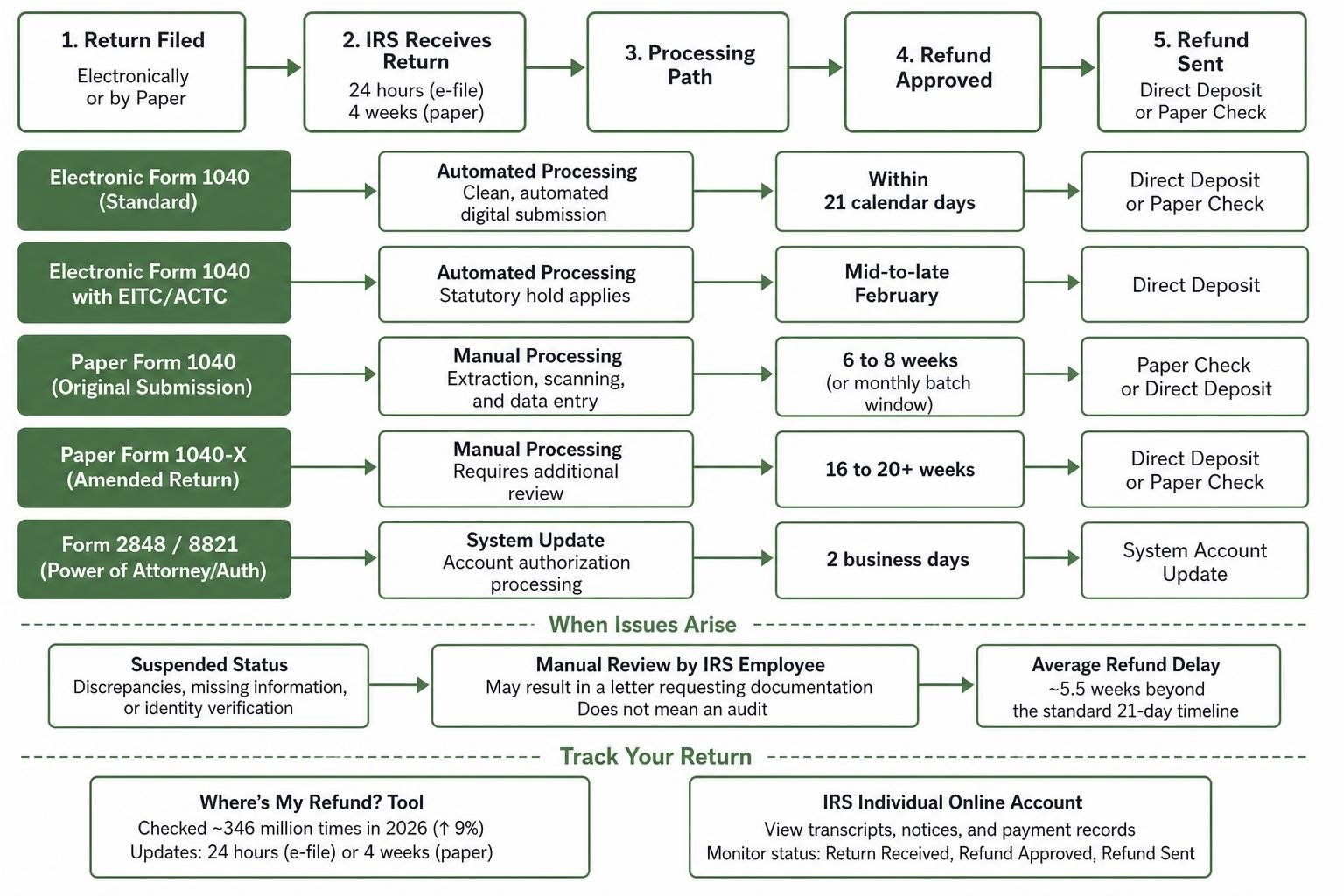
To check your status, you will need your Social Security Number (SSN) or Individual Taxpayer Identification Number (ITIN), your filing status, and the exact whole-dollar refund amount shown on your return. Status updates appear within 24 hours of electronic receipt or four weeks after mailing a paper return.
For a comprehensive view of account transcripts, notices, and payment records, taxpayers can log into their IRS Individual Online Account. Knowing how long after filing taxes do you get your refund gives you a baseline for when to expect status changes between “Return Received,” “Refund Approved,” and “Refund Sent.”
When and How to Contact IRS Phone Support
The IRS received 48.1 million phone calls during the 2026 filing season. Customer service assistors answered 9.9 million calls (about 21%), with an average hold time of 14 minutes.
Telephone representatives do not have access to additional refund information beyond what is displayed on the automated tools unless 21 days have passed since electronic filing (or 6 weeks for paper returns). For formal guidelines, consult the official Refunds | Internal Revenue Service documentation. When reviewing the average time for IRS to approve refund, calling before the standard 21-day window will usually result in an automated prompt directing you back to the website.
Where Is the IRS Processing Tax Returns and Transcripts for Prior Years?
Prior-year records, income verification transcripts, and amended returns require dedicated handling:
- Wage and Income Transcripts: Can be ordered online through the IRS Get Transcript tool or by mailing Form 4506-T. Online transcripts are available immediately, while paper mailings take about 5 to 10 business days.
- Amended Returns (Form 1040-X): Tracked through the “Where’s My Amended Return?” module. Processing can take up to 20 weeks.
- Address Changes: Submitted via Form 8822 (or Form 8822-B for businesses). These take 4 to 6 weeks to update in the master file.
Understanding how your federal tax return moves through the IRS machine clarifies why prior-year documentation and manual transcript requests follow distinct processing channels.
Why Your Federal Tax Return Might Be Delayed or Flagged
When a return is delayed beyond 21 days, the root cause is typically statutory compliance requirements, identity screening, or data mismatches. Reviewing common reasons for slow tax refunds helps pinpoint the specific issue.
Under the Protecting Americans from Tax Hikes (PATH) Act, the IRS is legally required to hold refunds claiming the Earned Income Tax Credit (EITC) or Additional Child Tax Credit (ACTC) until mid-February. Even if the rest of the return processes smoothly in January, the entire payment remains on hold until the statutory date passes.
If you discover that the IRS is holding my refund for review, it often relates to automated fraud filters comparing your reported income against employer-submitted W-2 and 1099 filings.
Common Taxpayer Errors That Trigger Review
Simple clerical errors frequently push clean e-filed returns into manual processing queues. Understanding what to do when your tax refund is stuck in processing limbo begins with reviewing common mistakes:
- Direct Deposit Inaccuracies: Transposed routing or bank account numbers prevent electronic delivery, causing the system to reject the transfer and mail a paper check.
- Name and SSN Mismatches: Spelling discrepancies or unrecorded name changes that do not match Social Security Administration records trigger immediate rejection or review.
- Math and Calculation Discrepancies: Incorrect calculations on standard deductions, taxable income brackets, or credit phase-outs require manual staff adjustments.
- Missing Schedules or Documentation: Failing to attach necessary reporting forms (such as Form 8962 for Premium Tax Credits) stops automated processing.
Identity Verification and Fraud Prevention Holds
Identity protection algorithms automatically flag suspicious filings, including sudden address updates, conflicting duplicate filings using the same SSN, or income amounts that differ from third-party reporting.
When a return is flagged, the IRS mails a verification notice (such as Letter 5071C, 6331C, or 4883C). Taxpayers must complete verification through the Taxpayer Protection Program online portal or over the phone before processing resumes. Understanding how come my federal refund is taking so long allows filers to respond promptly to verification notices and prevent extended delays.
Actionable Steps to Speed Up Your Refund or Resolve Delays
Taking proactive steps ensures your filing moves through processing pipelines without unnecessary friction:
- File Electronically with Direct Deposit: Submitting online eliminates physical mail handling and transcription delays.
- Keep Contact Information Current: If you have moved, file Form 8822 promptly so IRS correspondence reaches you without delay.
- Respond Immediately to Mailed Notices: Provide requested supporting documentation, schedules, or identity verifications as soon as a letter arrives.
Implementing practical strategies to expedite IRS processing minimizes review triggers. For comprehensive instructions on managing electronic payouts, refer to our direct deposit and delay survival guide.
How to Request Expedited Handling or Trace a Missing Refund
If your direct deposit was issued but has not posted to your account after 5 business days, you can initiate a formal refund trace using Form 3911 (Taxpayer Statement Regarding Refund). The Bureau of the Fiscal Service (BFS) will verify the transaction with the banking institution or issue a replacement check if the payment was lost or stolen.
In situations involving severe financial hardship—such as pending eviction, utility shutoffs, or medical emergencies—taxpayers can seek assistance from the Taxpayer Advocate Service (TAS). Reviewing our guide to getting a tax refund expedited outlines the criteria required to request case advocacy.
Frequently Asked Questions About IRS Processing Status
How long does the IRS take to approve a refund after acceptance?
Acceptance occurs within 24 to 48 hours of electronic submission, confirming that the return passed initial validation checks. Final refund approval and direct deposit scheduling typically occur within 21 days for clean e-filed returns. The Where’s My Refund? tool updates once daily, usually overnight.
Does calling the IRS speed up tax return processing?
No. Telephone assistors view the same processing records shown on the automated Where’s My Refund? system. Phone representatives cannot accelerate manual reviews or release statutory holds unless the standard processing window (21 days for e-file, 6 weeks for paper) has expired and an account error requires direct resolution.
What is the difference between tax return accepted and approved?
- Accepted: The IRS has received the return and confirmed that the personal identification details (names, SSNs, filing status) match official databases.
- Approved: The IRS has completed all automated processing, verified calculations and withholding credits, and approved the final refund amount. A specific direct deposit date is assigned at this stage.
Conclusion
The IRS is actively processing tax returns, delivering the vast majority of clean electronic filings within the standard 21-day window. Delays continue to center around paper filings, identity verification flags, missing schedules, and statutory credit holds.
While individual refunds generally move within weeks, complex business filings—such as the Employee Retention Credit (ERC)—operate on separate, extended processing schedules. For business owners in Travis County seeking to bypass administrative IRS backlogs on their payroll tax claims, explore SFG Capital business tax and claim solutions to learn how our performance-based ERC advances and buyouts provide reliable, accelerated capital.
See what your business may qualify for.
60 seconds. No documents. No upfront cost.
General information only, not legal or tax advice. Eligibility and estimates are fact-specific and subject to review.